TensorCar
This was the culmination of several months' worth of trying to teach myself machine learning. I wanted to teach a simulated car to drive a track with Q-learning in TensorFlow.
- When
- 2020
- Status
- Partial success
Overview
When I learned that Google’s DeepMind could beat a human at Go, I wanted to know how. I spent the next several months trying to teach myself machine learning. I don’t include all of those attempts here (I did demos ranging from simple fully connected networks for digit recognition to convolutional neural networks), but the culmination of this was to try to build my own reward-based Q-learning model.
How it works
First, I built a simple racing game in Python. This was fun, but not the most challenging or interesting aspect of the project. Once I got the controls working for myself, I moved on to building the model that I could train to beat it.
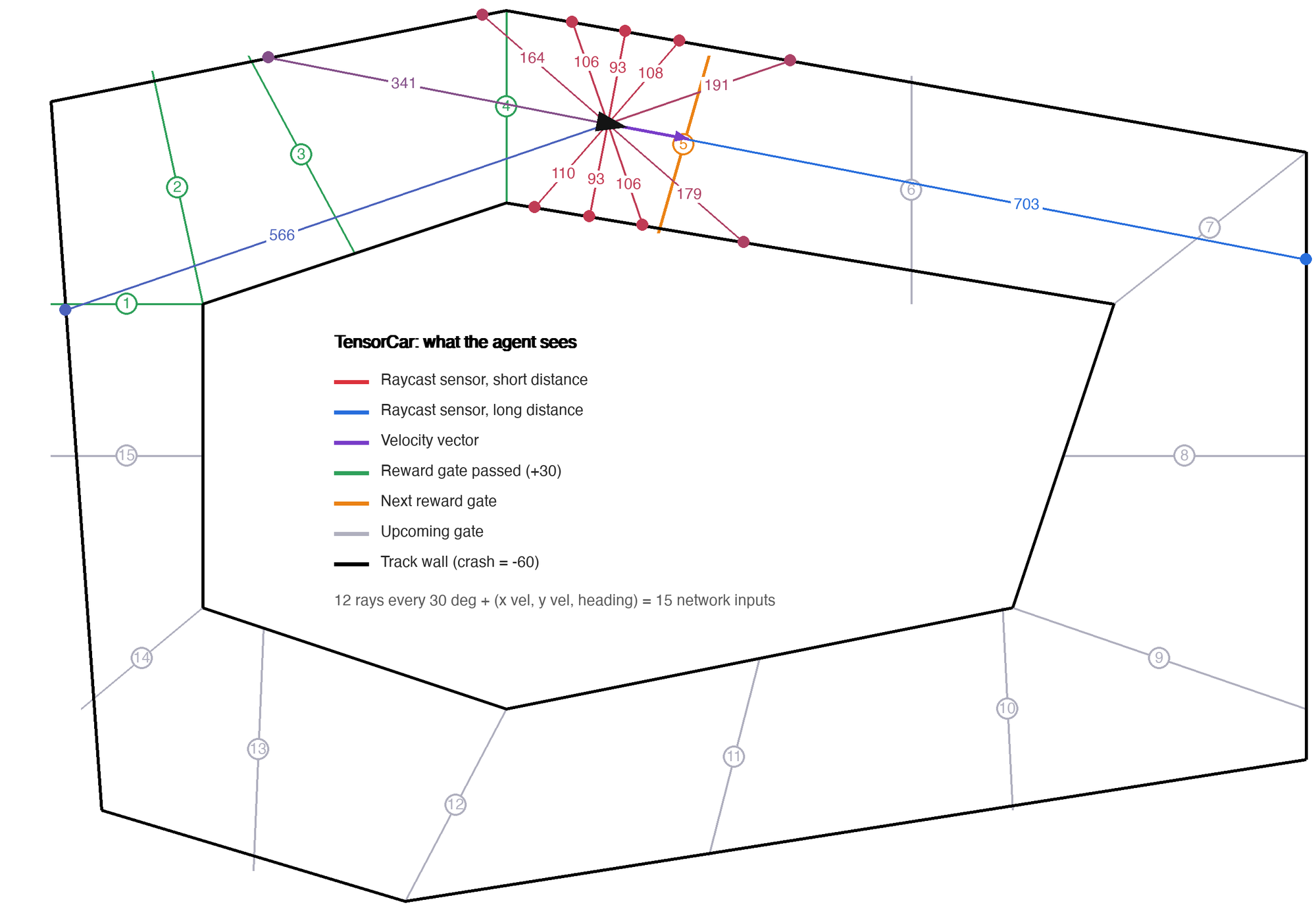
I wrote a script that gave me 12 raycast distance sensors (every 30 degrees) so the car would know where it was relative to surrounding walls. I also gave it the current velocity and heading, making for 15 network inputs. Then, I defined the outputs: coast, steer left, steer right, and thrust.
For rewards, I made a series of gates that it had to pass, as well as a punishment for hitting the walls and for taking too much time. The network itself had two fully connected layers of 50 nodes each, with ReLU activation.
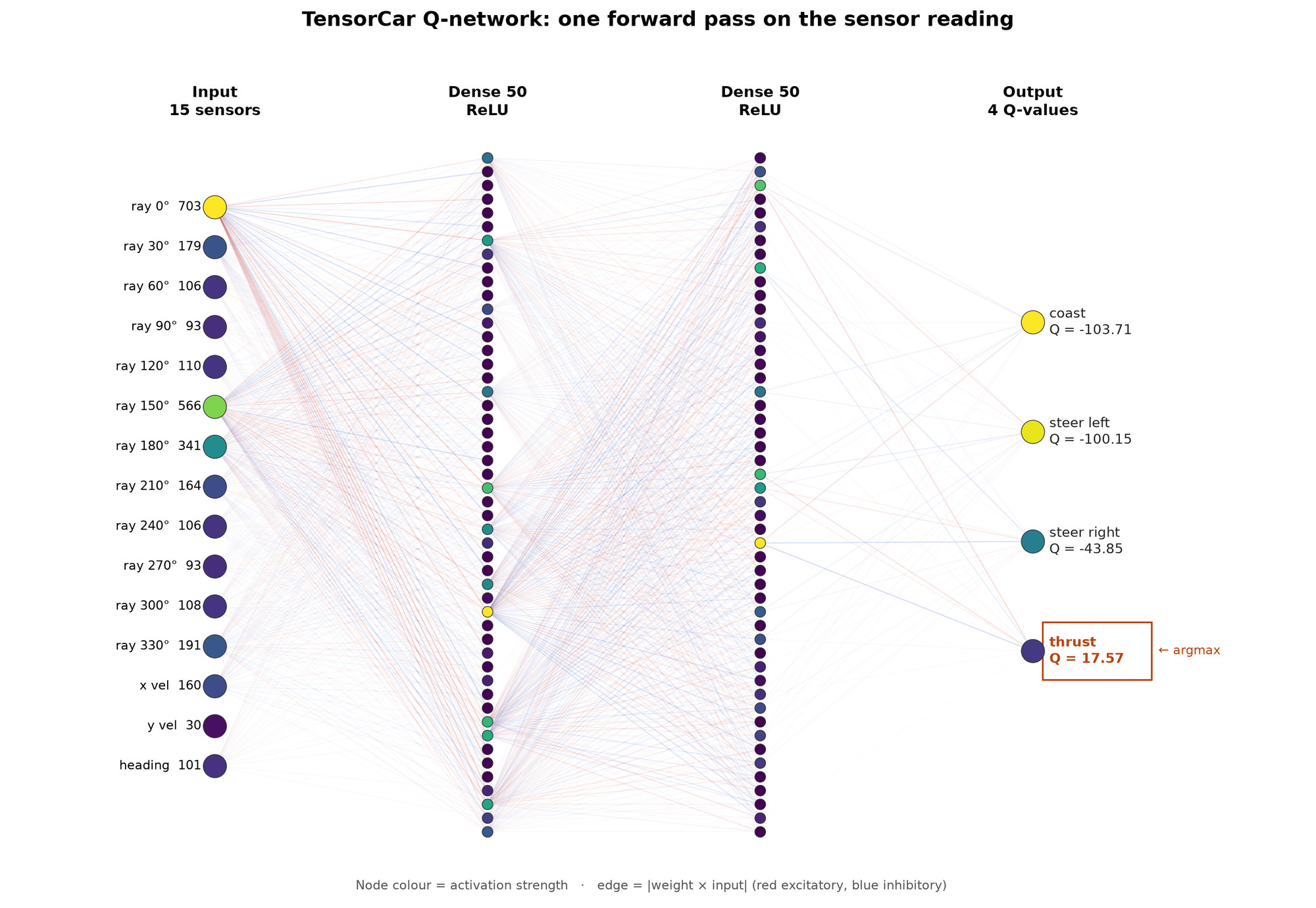 One forward pass of the Q-network on the sensor reading above. Here “thrust” has the highest Q-value, so the car accelerates.
Results
This was my first attempt at Q-learning. If my goal was to understand how it works, then it was a big success. If the goal was to make the car drive, less so. It managed to complete a full loop a few times, but was shaky and sometimes would crash partway through. It definitely did improve, but it was never as good as I was. I imagine a continuous reward function and better tuning of the time penalty, along with more training, could have improved this significantly. I also believe that adjusting the inputs to the network (different sensor data) could have helped.
If I learned a lesson, it’s this: machine learning can rise or fall on the smallest parameter tunings. It’s not easy! But it is really cool.