Simphony: Quantum Simulation of Photonic Circuits
I contributed to Simphony, BYU CamachoLab's open-source photonic integrated circuit simulator. I did work mostly on the quantum simulation side, including implementing density matrices and sum-of-Gaussian-states capabilities.
- When
- 2024
- Status
- Published
- Role
- Contributor, quantum simulation
- With
- BYU CamachoLab
Overview
Simphony is an open-source simulator for photonic integrated circuits developed by BYU’s CamachoLab. One of its main appeals is the ability to propagate quantum Gaussian states through classical circuit descriptions generated through Lumerical FDTD.
Up to this point, my previous research projects in my lab had dealt with the classical components of our systems, like noise and entropy extraction or FPGA control. This was my first project in which I had to learn and understand the quantum nature of light at a deeper level.
Beyond Gaussian states
Simphony represents quantum states as Gaussian states, with a vector of means and covariance. This can simulate coherent, squeezed, two-mode squeezed vacuum, and thermal states, but cannot represent states like single photons. The benefit of this tradeoff is that it’s very fast.
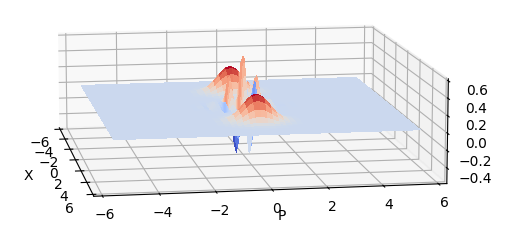
After working with other gaussian state simulators like Strawberry Fields, I learned that there was also a way to use the Gaussian quantum optics formalism to simulate sums of Gaussian states, like the cat state:
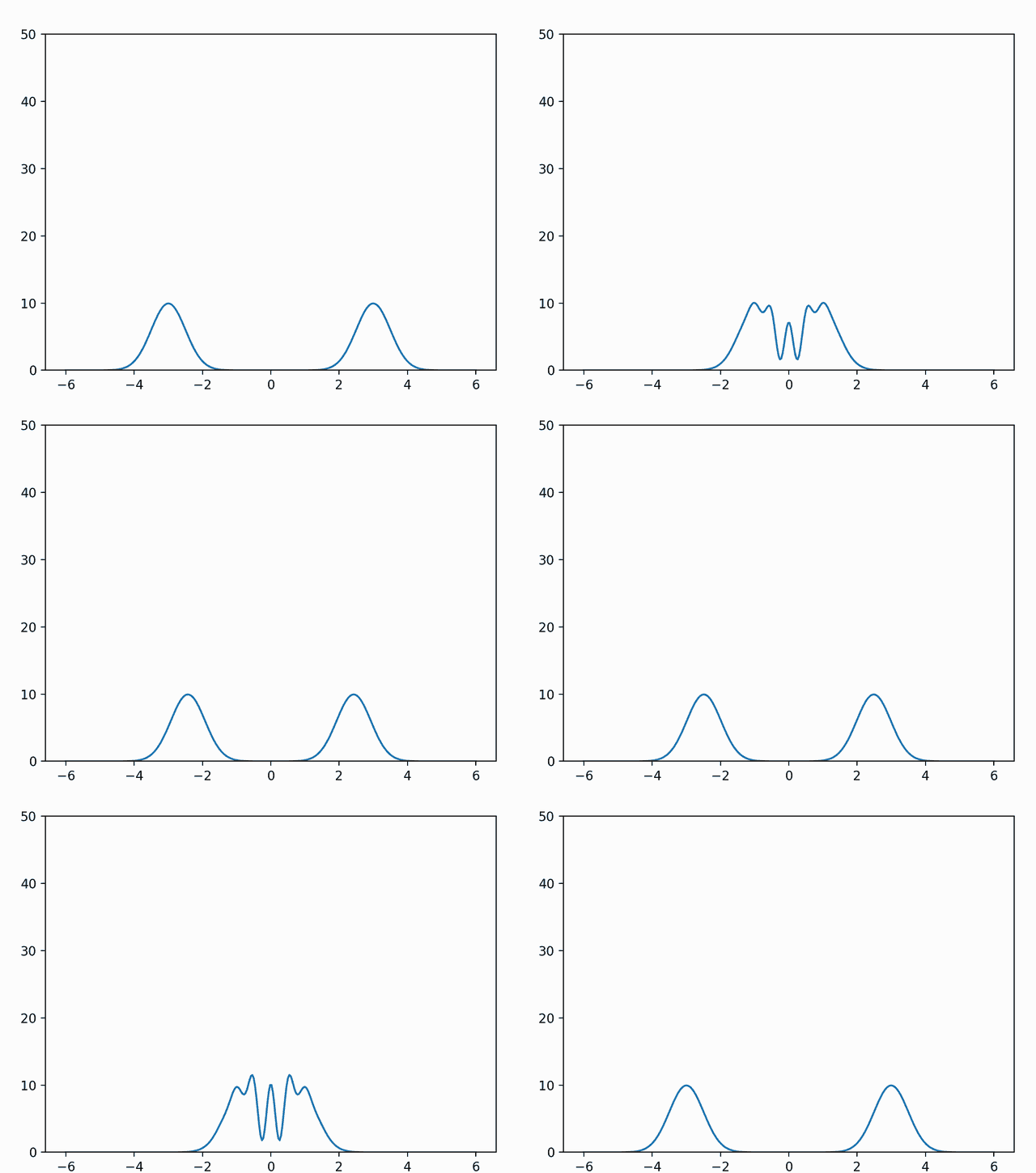
\[|\text{cat}_\pm\rangle \propto |\alpha\rangle \pm |{-\alpha}\rangle ,\]My work involved two parts. First, I added density matrix functionality to Simphony’s preexisting engine. Then, I worked on integrating sums of Gaussian states (like cat states), which are represented as four terms in a density matrix: the sum of two standard Gaussian terms and two complex cross terms. After propagating each term through the circuit, the Wigner distribution can be extracted.
Results
All of this lives on the quantum-interference branch. This project was significant because it was the first time I had to dive deep into the quantum theory of light. I understood how density matrices and the quantum harmonic oscillator worked at a deeper level, and felt more comfortable going out on my own.
Publication
(Note: this paper is from earlier work I did on Simphony’s initial quantum simulation capabilities.)
C. Carver, A. Probst, B. Arnesen, B. Fisher, T. Stowell and R. M. Camacho, “Device-Aware Quantum Photonic Simulator for Gaussian States,” Frontiers in Optics + Laser Science 2022, paper JTu4A.32 (Optica Publishing Group, 2022).